

Introduction
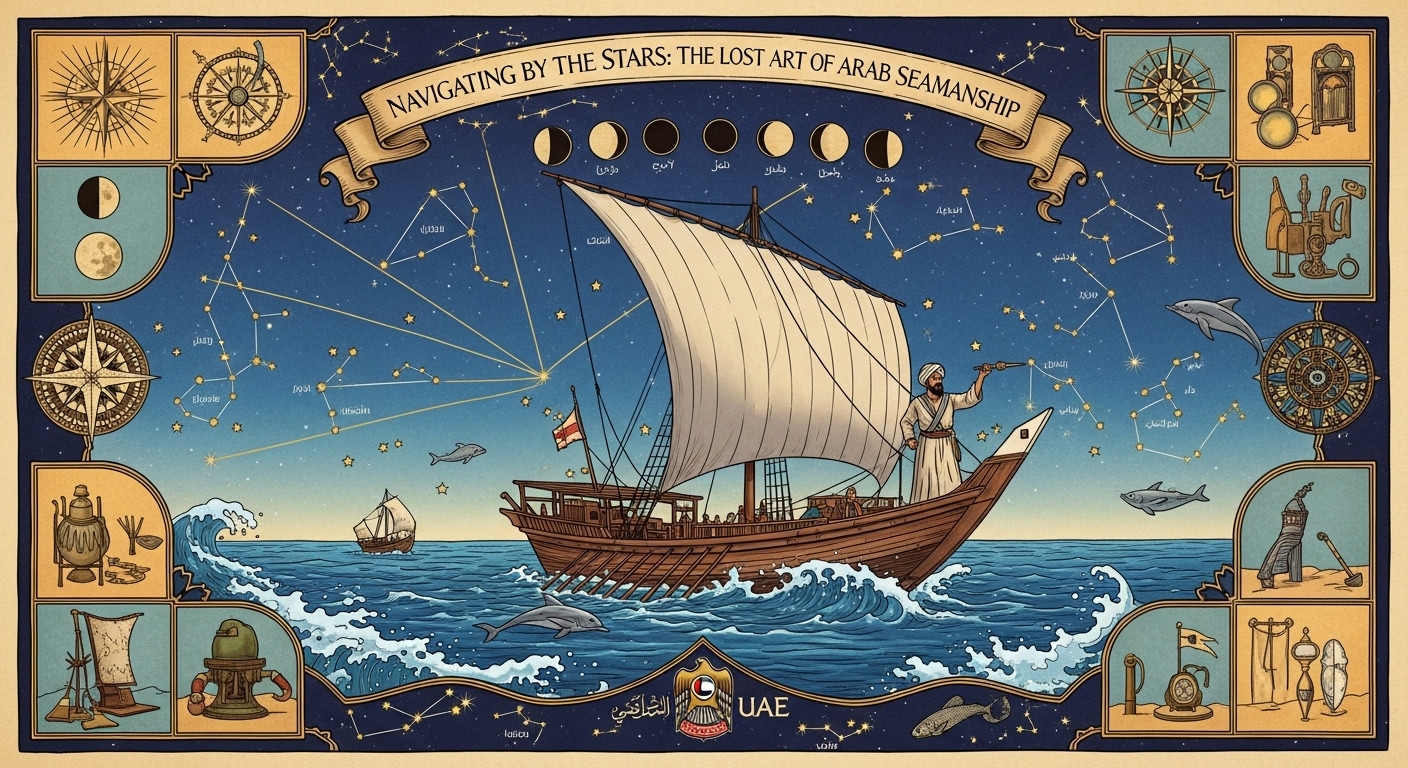
In the vast, featureless expanse of the open ocean, long before the invention of GPS or even the magnetic compass, Arab navigators undertook incredible voyages across the Indian Ocean. Their success depended on a profound and intimate knowledge of the natural world—a science of wayfinding known as Arab seamanship. By reading the stars, interpreting the waves, and observing the behavior of birds and sea life, these navigators, known as mu’allims, could guide their dhows with astonishing accuracy from the Arabian Gulf to the coasts of India and Africa. This lost art represents one of the most sophisticated intellectual achievements of the pre-modern world.
History
This celestial navigation system was developed and refined over thousands of years of Indian Ocean trade. Arab and Persian sailors were the primary custodians of this knowledge, which reached its peak during the Islamic Golden Age. Their voyages were timed to coincide with the predictable monsoon winds (Al Kaus), which blew from the northeast in the winter, carrying ships toward India and East Africa, and from the southwest in the summer, bringing them home. This knowledge was not written in formal textbooks but was passed down orally from father to son and from master (mu’allim) to apprentice through poetry, song, and practical experience aboard the dhow.
Key Features
Arab seamanship was a holistic system that integrated multiple sources of information:
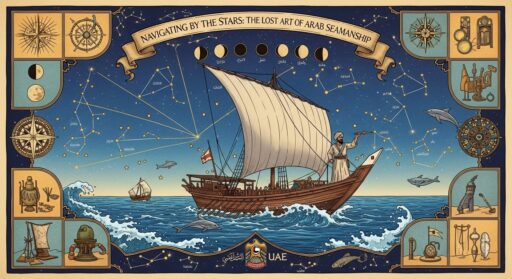
- Celestial Navigation (Ilm al-Anwa‘): The primary tool was the kamal, a simple wooden rectangle with a string. By holding the kamal at arm’s length, the navigator could measure the altitude of the Pole Star above the horizon, thus determining their latitude. They also used a complex mental map of the night sky, knowing the rising and setting points of specific stars for different destinations.
- Wave and Swell Patterns (Al Amwaj): Experienced navigators could “read” the ocean itself. They could feel subtle changes in swell patterns, which could indicate the direction of distant land or the approach of a storm.
- Observation of Nature: The presence of certain seabirds, the color of the water, the type of floating debris, and even the shape of clouds on the horizon provided critical clues about their position and proximity to land.
- Dead Reckoning: Navigators kept a mental log of their speed, direction, and time traveled, constantly updating their estimated position.
Cultural Significance
This art was more than a technical skill; it was a revered form of knowledge that commanded immense respect. The mu’allim was a figure of great authority and wisdom on the ship, often the captain himself. His ability to safely guide the vessel and its crew meant the difference between life and death, profit and loss. This knowledge system reflected a deep, almost spiritual connection to the environment, embodying the principle of observing and learning from God’s creation. It fostered values of patience, keen observation, and humility in the face of nature’s power.
Modern Relevance
While the traditional art of celestial navigation is no longer a practical necessity for commercial shipping, its legacy is profound. The astronomical knowledge developed by these early navigators contributed significantly to the field of astronomy. The principles of their navigation are still taught to sailors and aviators as a backup to modern technology. In the UAE, this heritage is a source of immense national pride, celebrated in museums and cultural festivals. The spirit of exploration and the ability to navigate challenging environments find a modern parallel in the UAE’s ambitious space program. The “Hope Probe” mission to Mars is, in a philosophical sense, the ultimate expression of this ancient legacy—a new generation of Emirati navigators using stars of a different kind to guide them on an unprecedented journey.
Conclusion
The lost art of Arab seamanship stands as a monument to human ingenuity. In an age of digital dependency, the idea of crossing an ocean using only the stars, the waves, and accumulated wisdom seems almost magical. Yet, for centuries, it was a commonplace reality for the merchants and sailors of the Arabian Gulf. This knowledge system was a brilliant fusion of science, intuition, and cultural tradition. It reminds us that the greatest technologies are not always the most complex, but are those that work in perfect harmony with the natural world, a lesson from the past that remains deeply relevant for our future.