

Introduction
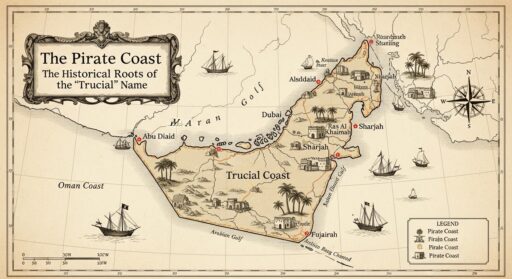
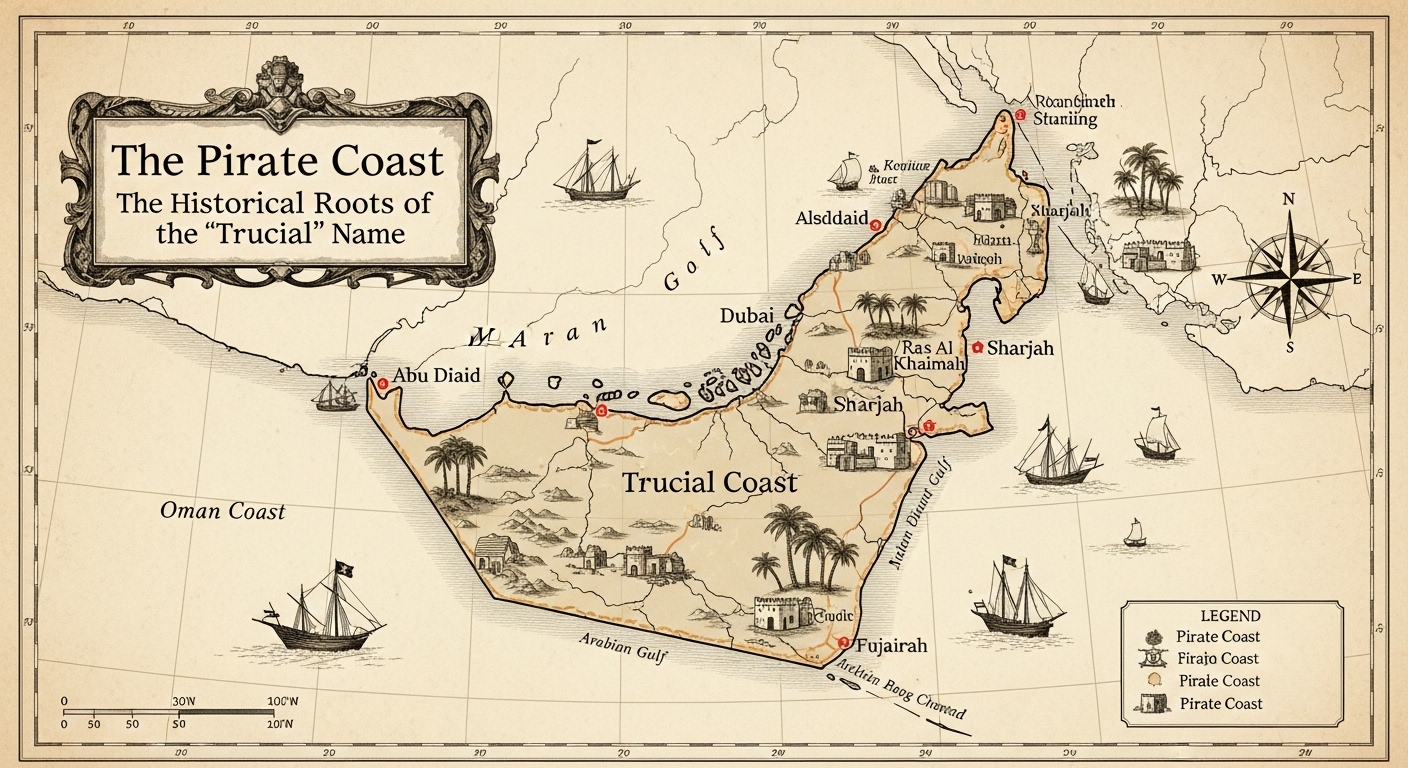
Long before it was known as the United Arab Emirates, the southern shore of the Arabian Gulf bore a more notorious name: the Pirate Coast. This label, given by 19th-century British historians and colonial officials, obscures a more complex reality of maritime conflict, emerging statehood, and economic survival. The era of piracy, and the subsequent British military response that led to the “Trucial” name, was a pivotal period that shaped the geopolitical destiny of the region, setting the stage for the protectorate relationships that would last until the federation in 1971.
History
The rise of maritime conflict in the late 18th and early 19th centuries was rooted in the shifting power dynamics of the Gulf. The decline of the central Omani empire and the growing rivalry between the British East India Company and the Qawasim tribal confederation (based in Ras Al Khaimah and Sharjah) created a volatile environment. The Qawasim, a powerful maritime force, saw British and Omani ships as competitors for control of the lucrative trade routes. From the British perspective, their attacks on Company shipping were acts of piracy. This culminated in a series of British naval campaigns against the Qawasim strongholds, known as the Anglo-Maratha Wars (1809-1820). The decisive British victory in 1819 led to the signing of the General Maritime Treaty of 1820, which imposed a permanent truce on the sheikhs, hence giving the region its new name: the Trucial Coast.
Key Features
This period was defined by conflict, diplomacy, and a clash of perspectives:
- A Clash of Definitions: The British labeled the Qawasim as “pirates.” However, from the local perspective, they were engaged in ghazw (traditional tribal raiding) and a form of naval warfare against a powerful foreign competitor encroaching on their waters.
- The General Maritime Treaty of 1820: This was the foundational document of the Trucial system. The sheikhs signed a “perpetual maritime truce” with the British, agreeing to cease all attacks on British shipping. They also agreed to refer any disputes with each other to the British for arbitration.
- The Perpetual Maritime Truce of 1853: This treaty renewed and strengthened the commitments of 1820, formally cementing the name “Trucial States.”
- The Exclusive Agreements: Later in the 19th century, the sheikhs signed further agreements promising not to cede any territory or enter into relationships with any other foreign power without British consent, effectively becoming a British protectorate.
Cultural Significance
The “Pirate Coast” narrative, largely written by the British, long overshadowed the indigenous history of the region. For the people of the coast, this was not an era of lawlessness but a time of asserting tribal sovereignty and resisting external domination. The transition to the “Trucial Coast” represented a forced pacification but also the beginning of a period of relative stability that allowed the pearling industry to flourish. The treaties established a direct, formal relationship between individual rulers and the British government, which had the effect of reinforcing the autonomy of each emirate, a political structure that would later be inherited by the UAE.
Modern Relevance
Understanding this history is crucial for a complete picture of the UAE’s formation. The Trucial system created the political boundaries and the model of external-managed security that defined the region for 150 years. It was the British withdrawal from this system in 1971 that provided the immediate catalyst for the formation of the UAE. The legacy of this era is also visible in the UAE’s modern foreign policy, which fiercely guards its sovereignty and makes its own strategic alliances, a clear departure from the exclusive agreements of the past. The “Pirate Coast” is now a subject of academic study and national museums, where the UAE presents its own nuanced interpretation of this complex chapter, reclaiming its history from a colonial narrative.
Conclusion
The journey from the “Pirate Coast” to the “Trucial States” is a story of how a region was defined by its interaction with a global empire. While the term “pirate” is a simplistic and biased label, the conflicts of that era were undeniably formative. They led to a century and a half of British oversight, which, while limiting full sovereignty, also provided a framework of stability. This period forged the diplomatic identity of the individual emirates and set the geographical stage upon which the visionary rulers of the 20th century would eventually build their united, independent, and globally engaged nation.